The Denver Broncos’ season did not end with a tackle, a turnover, or a final whistle blown into celebration or despair.
It ended on a patch of snow.
A thin, icy stretch of turf at Mile High Stadium became the most talked-about surface in the NFL, as Denver’s championship dreams slipped away — literally — beneath the foot of their kicker. What followed was not just a loss to the New England Patriots, but a league-wide debate that refuses to cool: When does football’s embrace of chaos cross the line into unfair randomness?
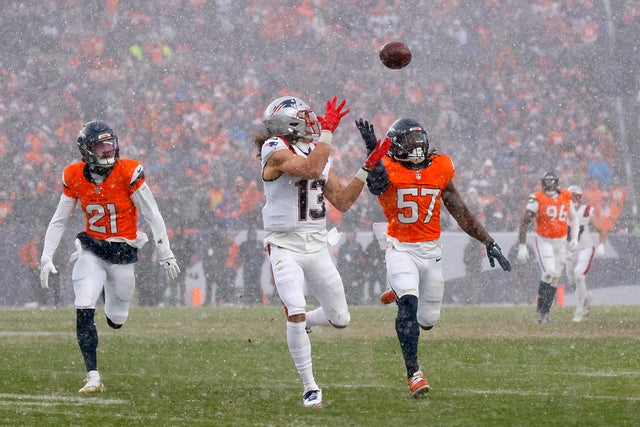
This was supposed to be Denver’s moment.
Instead, it became a frozen memory they may never escape.
A Night Built for Belief
January football in Denver carries a certain mythology. The altitude. The cold. The roaring crowd wrapped in layers and history. Mile High has long been considered one of the league’s most punishing environments for visiting teams, especially when the stakes reach their peak.
From kickoff, the atmosphere felt heavy with destiny.
Snowflakes began falling early, gentle at first — the kind that fans romanticize and broadcasters praise as “perfect football weather.” But as the night wore on, those flakes thickened. Wind shifted. Footing became treacherous. And the field, once a symbol of home-field advantage, slowly transformed into something far more dangerous: unpredictable.
Denver battled through it all.
The Broncos’ defense refused to yield, bending but never breaking. Hits echoed through the thin air. Coverage tightened. Every Patriots advance was met with resistance. The crowd fed off it, growing louder with every stop, every third-down stand, every moment that suggested this night might belong to them after all.
But football games, especially playoff games, rarely hinge on effort alone.
They hinge on moments.
The Kick That Changed Everything

Late in the game, with the score tight and tension suffocating the stadium, Denver found itself in position to seize control. It wasn’t a perfect setup, but it was familiar. A field goal attempt — the kind practiced thousands of times, the kind fans assume will be automatic.
Until it wasn’t.
As the kicker approached, his plant foot struck snow-packed turf. Not visibly dramatic. Not cartoonish. Just enough. Enough to disrupt timing. Enough to shift balance. Enough to send the ball wide.
The stadium froze.
Then it exhaled in disbelief.
One kick.
One slip.
One frozen moment that instantly rewrote the night.
What should have been points became nothing. What should have been momentum became doubt. And what should have been Denver’s advantage became New England’s opening.
From Miss to Momentum
Football is ruthless in how quickly it punishes mistakes.
The Patriots didn’t celebrate the miss loudly. They didn’t need to. They understood what it represented. A door had opened — and championship teams are trained to walk through doors without hesitation.
New England took the field with renewed confidence. Their quarterback played with calm efficiency, unfazed by the snow or the noise. Short passes neutralized pressure. The run game stabilized the tempo. Every yard gained felt heavier than the last, not because of distance, but because of consequence.
Denver’s defense, heroic all night, suddenly found itself fighting more than just an opponent. They were fighting time. They were fighting field position. And they were fighting the creeping realization that the game had turned on something they couldn’t control.
By the time the Patriots delivered the finishing blows, the narrative had already shifted.
This was no longer about a missed kick.
It was about what that miss unlocked.
Immediate Fallout: Excuse or Explanation?
The reactions were instant — and explosive.
Patriots fans dismissed the talk of snow as convenient deflection. Football is played outdoors, they argued. Weather affects everyone. Execution separates champions from excuses.
Broncos Country saw it differently.
They didn’t deny the miss. They didn’t absolve responsibility. But they questioned whether the conditions had crossed an invisible line. Was this still football? Or had the field itself become an uncontrollable variable in a game meant to be decided by skill?
Inside Denver’s locker room, frustration simmered just beneath the surface. Publicly, players took accountability. Missed chances. Missed assignments. Missed execution.
Privately, questions lingered.
How consistent was the footing?
Why did conditions deteriorate so sharply late?
At what point does “home-field advantage” become “competitive risk”?
No one wanted to sound like they were blaming the snow.
But no one could ignore it either.
The League-Wide Debate Ignites
Within hours, the conversation spread far beyond Denver.
Former players weighed in on television panels. Coaches debated it behind closed doors. Analysts replayed the kick from every possible angle, slowing down the plant foot, the turf, the moment of slip.
Social media erupted.
Some celebrated the chaos — calling it “real football,” the kind rooted in tradition and unpredictability. Others called it unacceptable, arguing that championship moments deserve controlled conditions, not environmental roulette.
The NFL, famously protective of its image, offered no immediate response.
Because officially, nothing was wrong.
The field passed inspections. The game went on. The result stood.
History, after all, rarely pauses for nuance.
What History Will Remember — And What It Won’t
Years from now, box scores will not mention snowfall.
Stat sheets won’t note icy patches or unstable footing. Highlights won’t slow down on the plant foot that slipped — they’ll show the ball missing the uprights, the Patriots celebrating, the Broncos walking off in stunned silence.
History remembers winners.
But fans remember moments.
For Denver, this moment cuts deep because it wasn’t about being outplayed. It wasn’t about being overwhelmed. It was about being undone by something that felt just out of their control.
That distinction matters.
Because losses that expose weakness can be corrected.
Losses that feel random linger.
The Human Cost of a Missed Moment
For the kicker, the weight is unbearable.
Specialists live on a razor’s edge. They are asked to be perfect in chaos, invisible until needed, unforgettable when they fail. One slip can overshadow years of reliability.
Teammates offered support. Coaches defended him. But the silence of Mile High after the miss told its own story — not anger, but shock.
Shock that a season, built on resilience and belief, could end so abruptly.
Shock that something as simple as footing could dictate destiny.
January Football: Tradition or Liability?
At the heart of this controversy lies a philosophical question the NFL has never fully answered.
Should January football embrace chaos?
Or should the league, now a multi-billion-dollar enterprise, protect its biggest moments from randomness?
Cold-weather cities pride themselves on grit. Snow games are marketed as iconic. Fans wear them like badges of honor.
But as the league evolves — faster, more precise, more commercial — the margin for uncontrollable variables shrinks.
At what point does tradition stop serving the game?
And at what point does chaos stop being fair?
Denver’s Season Ends — But the Debate Doesn’t
For the Broncos, there is no appeal. No rematch. No asterisk.
Their season is over.
What remains is the ache of “what if,” the cruelest companion in sports. What if the footing held? What if the snow slowed for just a moment? What if that kick went through?
What if the moment hadn’t slipped away?
Instead, Denver is left with silence, snow-covered turf, and the knowledge that they were close — painfully close — to something more.
A Loss Bigger Than the Score
Denver didn’t just lose a game.
They lost control of a moment they had earned.
They lost a chance that may not come again soon.
They lost in a way that will be argued, replayed, and remembered — even if officially, it never mattered.
Because championships are remembered by winners.
But controversies are remembered forever.
And on this frozen night at Mile High, snow didn’t just fall.
It decided everything.