The final whistle should have ended the story.
Instead, it ignited one.
Within minutes of the game ending, the narrative escaped the stadium and exploded into the digital bloodstream of the NFL world. Not analysis. Not celebration. Not breakdowns of schemes or execution.
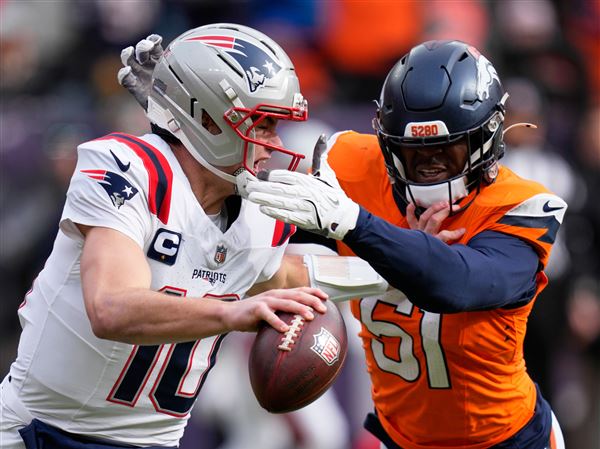
Outrage.
Social media detonated with surgical precision. Clips looped endlessly. Screenshots froze time. Slow-motion breakdowns dissected moments that, in real time, lasted less than a second but now carried the weight of an entire season.
Missed holding calls.
Questionable pass interference no-calls.
Flags thrown late — or not thrown at all.
And a single, toxic narrative took hold with alarming speed:
When Denver needed fairness, the whistle went silent. When New England needed help, it screamed.
This wasn’t just fan frustration.
It was accusation.
And accusations, once unleashed, do not wait for proof.
The Patriots had won. The scoreboard confirmed it. History would record it as another postseason advancement for one of the most successful franchises the league has ever known.
But perception doesn’t care about history.
Perception cares about patterns.
And this is where things became dangerous.
No proof has surfaced.
No investigation has been announced.
No official wrongdoing has been alleged by the league.
Yet none of that slowed the momentum.
Because in the modern NFL, perception spreads faster than facts ever could.
Broncos Country didn’t see a clean loss.
They saw momentum stolen.
They saw drives killed selectively.
They saw playoff pressure that didn’t just affect players — but reached the officials standing between the lines.
And once fans believe the game was tilted, the conversation stops being about football.
It becomes about trust.

From the moment the Patriots’ late drive began, every snap was scrutinized. Not just for execution — but for omission. For what wasn’t called. For what could have been flagged.
Denver fans replayed the tape with a forensic obsession. Every frame felt like evidence. Every missed call felt intentional. Every flag in New England’s favor felt amplified.
Fair or not, the optics were brutal.
The Patriots weren’t just winning.
They were winning while controversy followed them like a shadow.
Patriots fans pushed back immediately, and aggressively. They called it conspiracy. They called it coping. They called it the predictable reaction of a fanbase unable to accept defeat.
“Good teams get blamed,” they argued.
“Champions don’t apologize,” they said.
“Where was this energy when calls went against us?”
And they weren’t wrong — not entirely.
The NFL has never been officiated perfectly. Every playoff run in history contains moments that could have gone the other way. Every champion benefits from something breaking their way.
But critics weren’t arguing perfection.
They were arguing pattern.
And once that word enters the conversation, the damage becomes unavoidable.
Because the Patriots don’t exist in a vacuum.
They exist in history.
Decades of dominance.
Decades of controversy.
Decades of whispers — some proven, some exaggerated, some never resolved.
Spygate.
Deflategate.
Rule-bending.
Edge-seeking.
Fair or unfair, those memories linger.
So when a whistle becomes the headline in a Patriots playoff win, it doesn’t feel isolated.
It feels familiar.
And familiarity breeds suspicion.
Neutral fans began weighing in, not with emotion, but with unease. Analysts chose their words carefully. No one accused. No one confirmed. But phrases like “optics,” “timing,” and “consistency” dominated the conversation.
Former players spoke cautiously.
“This is a hard game to officiate,” they said.
“Things happen fast,” they added.
“But I understand why people are upset.”
That sentence alone was enough to fuel the fire.
Because in controversy, validation doesn’t require agreement.
It only requires acknowledgment.
Inside the Broncos locker room, emotions boiled just beneath the surface. Players avoided direct comments about officiating, knowing the fines, knowing the politics. But body language told its own story.
Shrugs.
Tight smiles.
Silence that spoke louder than any quote ever could.
They felt wronged.
Not robbed by one call — but by a sequence of moments that all leaned in one direction.
Denver believed they had earned the right to a fair ending.
Instead, they were left with rage.
Rage at what they couldn’t control.
Rage at what they couldn’t prove.
Rage at a system that, in their eyes, failed them when the margin for error was already razor-thin.
The league, meanwhile, stayed quiet.
As it always does.
No statement.
No clarification.
No acknowledgment beyond standard officiating reviews buried deep in procedural language.
Because the NFL understands something fans often forget:
Admitting doubt is more dangerous than ignoring outrage.
But silence has consequences too.
When the whistle becomes the headline, the game loses control of its narrative. The sport shifts from competition to credibility. From performance to perception.
And that’s where the NFL finds itself again.
New England advances.
The standings update.
The schedule moves on.
But the conversation doesn’t.
Because for Denver, this wasn’t just a loss.
It was a spark.
A spark that reignited old fears about fairness, favoritism, and power in a league built on billion-dollar stakes.
A spark that reminded fans how fragile trust really is.
A spark that ensures this game will be remembered not for who won — but for how it felt.
Championships are supposed to silence doubt.
This one amplified it.
And until the league finds a way to make the whistle invisible again, every close game, every critical flag, every playoff moment will carry the same question:
Was it earned — or was it helped?
That question doesn’t need an answer to cause damage.
It only needs belief.
And belief, right now, is burning.